When Mary Hollow joined Prickly Pear Land Trust as executive director in 2015, her job was to prepare the organization to be impactful in a changing community. One of her priorities was to expand the work beyond singletrack trails in the South Hills. “It was clear to me that if we didn’t evolve with the times, we were going to be less relevant in the future,” Mary says. “We had a huge opportunity to bring new public access to this region.”
The Peaks to Creeks Initiative brought PPLT’s work from the mountains into the Helena Valley, which was fertile ground for conservation. In 2016, PPLT partnered with the National Guard to purchase 205 acres of pasturelands adjacent to Fort Harrison and Tenmile Creek. The property became a priority when plans for a 700-unit subdivision fell through. The partnership also supported PPLT’s conservation of 358 acres along Sevenmile Creek.
Military funding only covered a portion of the project, leaving PPLT to raise matching funds. After extensive debate, the board signed off on a $3 million loan. “If I knew then what I know now, I may not have recommended it because finances were so risky,” Mary says candidly. “But there’s a lot of value in grit, determination, and doing the right thing if the community is behind you. And thank God it was!” The Lewis and Clark County Open Spaced Bond also funded the project.
The community rallied behind and celebrated the acquisitions, and the land trust had the right on-the-ground leader in PPLT veteran Nate Kopp. Individuals, businesses, government agencies, and nonprofits helped create Tenmile Creek Park. They moved rocks, made seed balls, planted trees, and built trails. At Sevenmile, that same effort restored the creek back into the floodplain, added a half mile of meanders, stabilized the banks with sand, rocks, and vegetation, and created new wetlands and ponds.
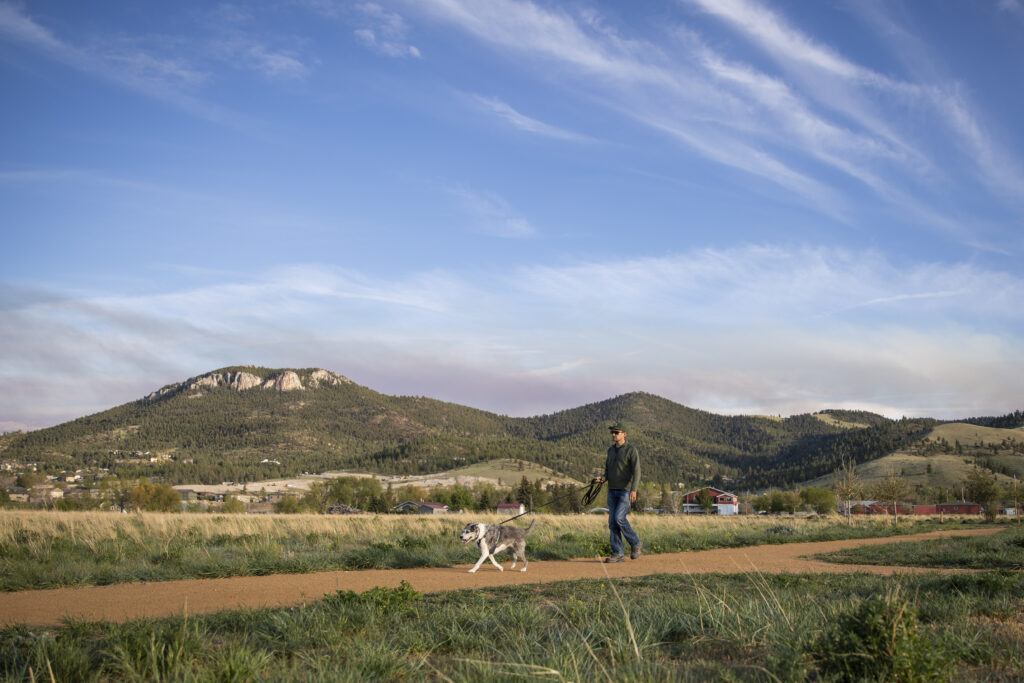
Last year, there were 75,000 park visits at Tenmile. Those visits equal dog walks, bike rides, afternoons fishing and splashing in the creek, mental health breaks, and millions of smiles. At Sevenmile, high school students study ecology, biology, and plant willows, and volunteers learn about wildlife and water conservation. That “risky” financial decision has paid off big for our community.
Trial by Fire (and Flood)
Tenmile Creek Park flooded twice in three years after it opened to the public. Far from being a failure, that flooding signaled the wisdom of protecting floodplains from development. The homes that weren’t built there would have been underwater. Extreme weather events demonstrate the value of open space and healthy creeks.
The semi-arid Lake Helena Watershed receives only 12 inches of precipitation a year. Prickly Pear Creek, Tenmile Creek, and their tributaries flow into Lake Helena, which in turn feeds the Missouri River. Fifty years ago, the streams were snowfed, and agriculture dominated the valley. Flood irrigation and gradual snowmelt combined to recharge our groundwater and keep streams clean and cold throughout the summer.
Today, the way water moves through the valley has changed. More subdivisions mean less flood irrigation. Precipitation trends have also changed. Spring rain in the mountains means the snowpack melts quickly. These trends mean less groundwater recharge and warming waters where fish and bugs struggle to breathe.
“Owning land with water rights is a smart investment for a land trust,” says Mike Roberts, hydrologist and PPLT board member. “At Sevenmile Creek, we can irrigate in the spring, grow forage, create habitat for upland birds, and protect instream flows to keep the trout happy. Land trusts that own property can make those kinds of choices.”
In the spring, Tenmile and Sevenmile absorb floods and recharge the groundwater. In the summer, they do double duty as a fire break. This theory was tested in 2020, when high winds drove the Birdseye Road Fire across the valley towards residential areas. The fire scorched the Sevenmile property, but the restored streambed and wetlands and the managed grasslands acted as a natural dampener and stopped the fire in its tracks.
“Open spaces protect homes and neighborhoods,” says Lois Olsen, executive director of Tri-County Firesafe Working Group. “If a fire comes off the Scratchgravel Hills and heads towards town, Tenmile Creek Park is a great place to burn off. It’s easy to catch and stop a fire on open ground.”
By protecting floodplains and grasslands, PPLT has created a space where firefighters can actually make a stand or let a fire burn out without risking lives. “It is four times more expensive to fight a fire than to prevent it,” Olsen says, demonstrating the inherent financial benefits of land conservation.
Lands Director Travis Vincent spent his first week at PPLT with a shovel in his hands, trying to save the new bridge at Tenmile Creek Park from flooding. Ten years later, he says, “Looking back at the floods and the fires that tested these properties, it’s safe to say the proof is in the puddles.”
Sarah Ryan is the communications and development manager at Prickly Pear Land Trust.