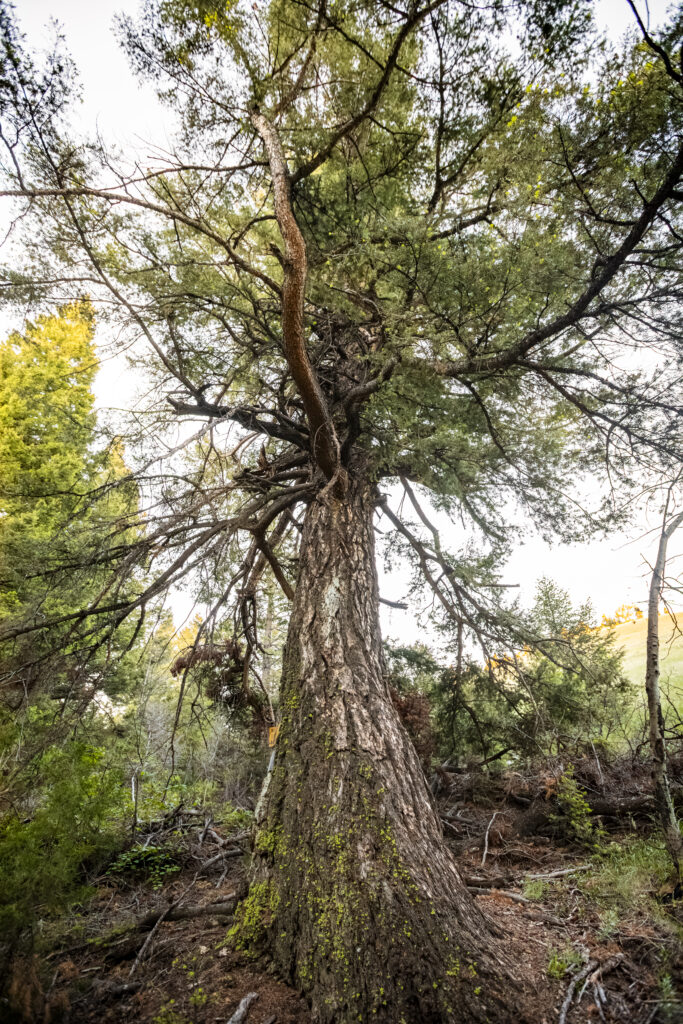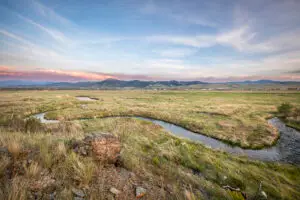
Every piece of land we protect has a story to tell. At War Eagle Hill, that story begins with an ancient Douglas-fir that has stood watch over this landscape for centuries. Towering over its neighbors at the edge of an old-growth riparian area, this witness tree started as a seedling hundreds of years ago and has persisted through its natural adaptations and resilience to change. Because of its large size, we don’t have the tools to measure its exact age, but our experience indicates that it is likely between 300 and 600 years old. Since acquiring
the 198-acre War Eagle Hill property, we’ve found ourselves wondering about this biological legacy and celebrating its perseverance on the landscape.
We certainly aren’t the first people to observe this stately resident of the forest. It may well have been encountered in its youth by the indigenous peoples who lived, hunted, and traveled through this area since time immemorial. It was probably a sapling when the first European explorers landed on American shores and a young adult when the United States won its freedom.
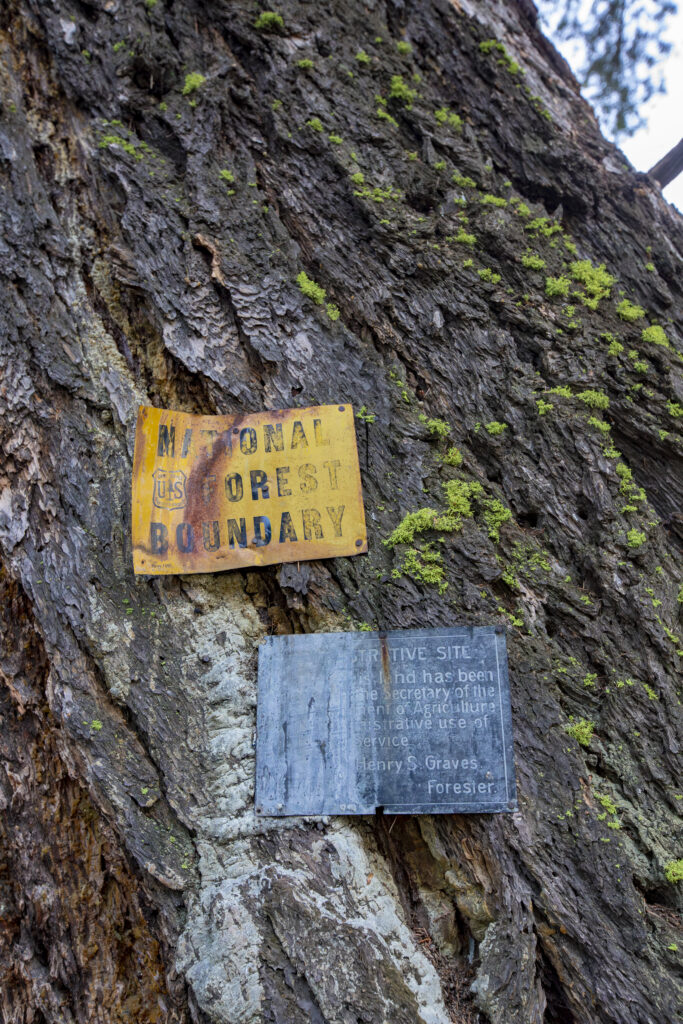
It was undoubtedly here when Lewis and Clark journeyed west, when the Mullan Pass wagon road was built, when the railroad came through, and when miners put shovels to earth seeking valuable minerals. Sometime between 1910 and 1920, a sign bearing the name of Henry Graves, the second chief of the newly formed Forest Service, was installed on this tree marking the boundary of the Helena National Forest. More recently, families have routinely gathered on the War Eagle Hill property to camp, hunt, and reconnect with each other and with nature.
The tree’s story is about natural cycles as well as human ones. It lived through many climate periods and natural disturbances over the centuries. Moist climate periods ushered in vegetation growth, while drought initiated disturbances such as wildfire and insect outbreaks that thinned the forest and maintained the grasslands. Charred tree remnants and numerous lightning strike scars on living trees can still be found throughout this forest, serving as reminders of the natural fire regime that killed smaller trees while “fire-hardening” the survivors. Those survivors then went on to endure, grow, provide wildlife habitat, and produce seed for future generations of trees.
Although many of the lightning scars are more recent, fire history suggests the last major fire to burn this site likely occurred in the late 1800s. After that, fire suppression and land fragmentation began in earnest. Recent Forest Service analysis shows that less than 600 acres burned in the Divide landscape of the Helena National Forest between 1940 and 2016, compared with a historic average of 35,000 acres per decade.
The turn of the last century initiated a period of rapid change that continues today. As the newest steward of War Eagle Hill, Prickly Pear Land Trust is proud to play a role in the next chapter of this tree’s story – one of conservation and continued resilience. We plan to protect the site’s historical and cultural features while managing the land in ways that maintain and restore its vibrant ecosystem by treating invasive weeds and removing encroachment of small trees in the old-growth forest and grasslands. We hope this legacy tree will continue bearing witness to the preservation of this open land before eventually providing a luxury home for snag-dependent wildlife species.
We’re also excited to open the property through the Montana Fish, Wildlife & Parks’ Block Management Program so that you too might have the opportunity to find this tree, place your hand on its bark, and imagine its whispers from the past. We hope that you’ll come to appreciate it as a symbol of our shared history and of the natural wonders found near the places that we’re fortunate enough to call home. It serves as a reminder that some things are worth preserving and that our open spaces remain just as relevant to people today as ever.
Amanda Milburn is the lands project coordinator for PPLT.