Building a new trail is a balancing act. Long before we break ground, we’re weighing the needs of trail users, nearby property owners, local wildlife, and the landscape itself. We consider trail density, off-trail use, safety, and, of course, the priorities of the land manager. Every new trail is a series of tradeoffs, and every decision shapes the experience people will have for years to come.
When we have buy-in from the community, the proposed trail fills a need, and the land manager approves a new trail, then I go out to scout. I’ll bring my team and partners out with me, and together we will look at the potential of the landscape.
Scouting is also a balancing act. It’s about incorporating destinations like overlooks with vistas or cool trees with an eye towards sustainable grading and making the best use of the available landscape. It’s also about balancing how various users with different strengths and abilities want to navigate the landscape. A beginner biker wants to climb differently than a hiker with a dog. An adult biker riding with children is going to have different priorities than an advanced hiker or a group of advanced bikers. Choosing a path that will satisfy as many people as possible is often the goal.
I’ve worked in recreation trails for more than a decade, and most of that time was spent maintaining trails built long ago. It is hard work. I once referred to the role as “dirt janitor” as a joke and immediately realized it was a little too on-the-nose. Back when I led a Forest Service trail crew in the Scapegoat Wilderness, we’d work eight 10-hour days in a row, often covering more than 10 miles a day with our work packs and tools, merrily doing the manual labor of clearing downed trees, clearing drains and digging retread. One coworker described the work as, “picking stuff up and putting it back down.” Once again, a little too on the nose.
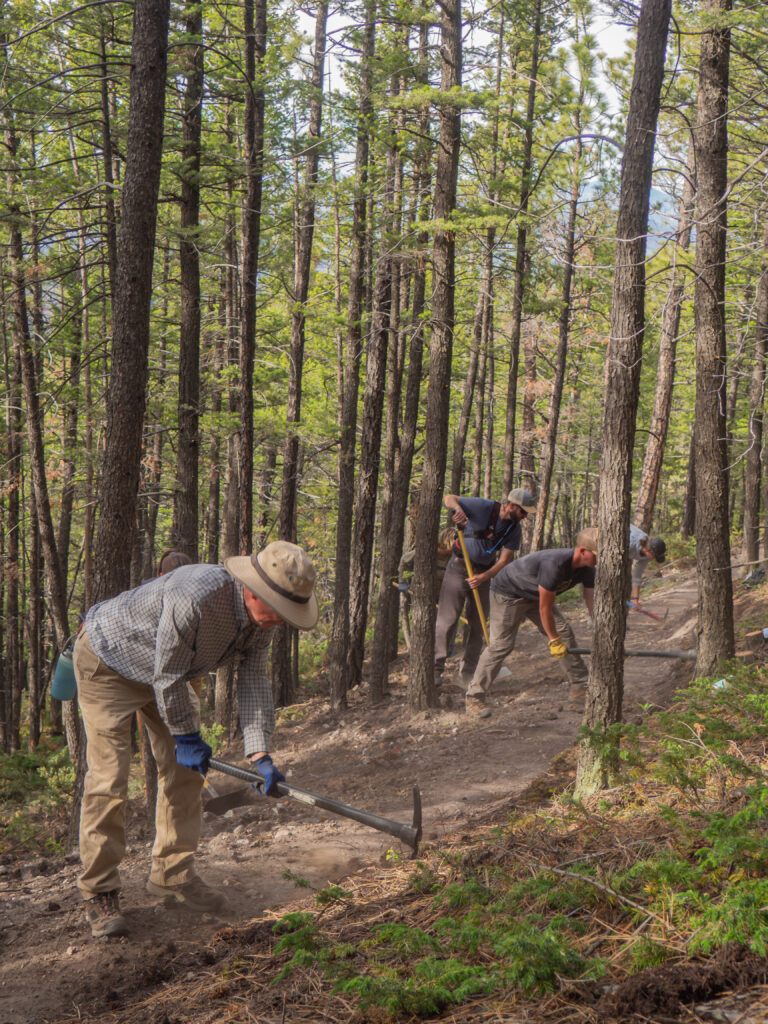
The opportunity to build a new trail is a real treat. So when I’m able to dream up a trail, secure grant funding for it, put in the long days preparing the corridor by removing trees, downfall, and stumps, and then spend countless hours digging the trail itself alongside PPLT volunteers and Montana Conservation Corps crews, the demands of ongoing maintenance are never far from my mind.
A good trail works well for many different activities and skill levels. It incorporates what people want to see – a great view, a cool rock outcropping, or a stand of old trees – and it’s built in a way that it will largely maintain itself. Lastly, I want the trail to live up to the vision of the partners who helped us put a new trail on the ground, like the Forest Service, and I want our community to appreciate it.
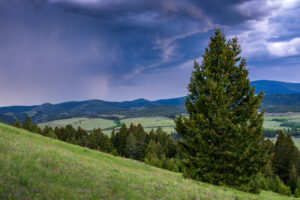
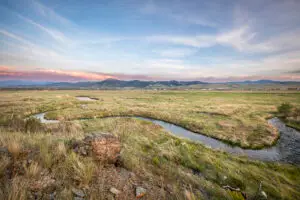
The new trail from Pinchot to Top of the World is just over a half-mile long. It required more than 300 volunteer hours and more than 800 MCC service member hours, not to mention the blood, sweat, and time of our great trail team of Collin Ahlmeier and Emmett Purcell. It is essentially a connector trail, with steady climbs and contours throughout. It reminds me of a condensed Aftershock Trail. We wanted to spread out use in the Rodney Ridge area, capture grand views
of the Wakina Sky area, Mt. Helena Ridge Trail, and Skihi Peak, while making use of the meadow, large trees, and rock outcroppings.
I recently had the opportunity to ride from my front porch to the Top of the World after hiking it countless times during the trail-building process. Sitting on my bike at the top of that ridge, looking out over our community after traveling on trails we’ve built and maintained, was incredibly satisfying. It’s exactly why I do this work.
Tim Lawrence is the trails and parks manager at PPLT.